Java Persistence with Spring Data and Hibernate
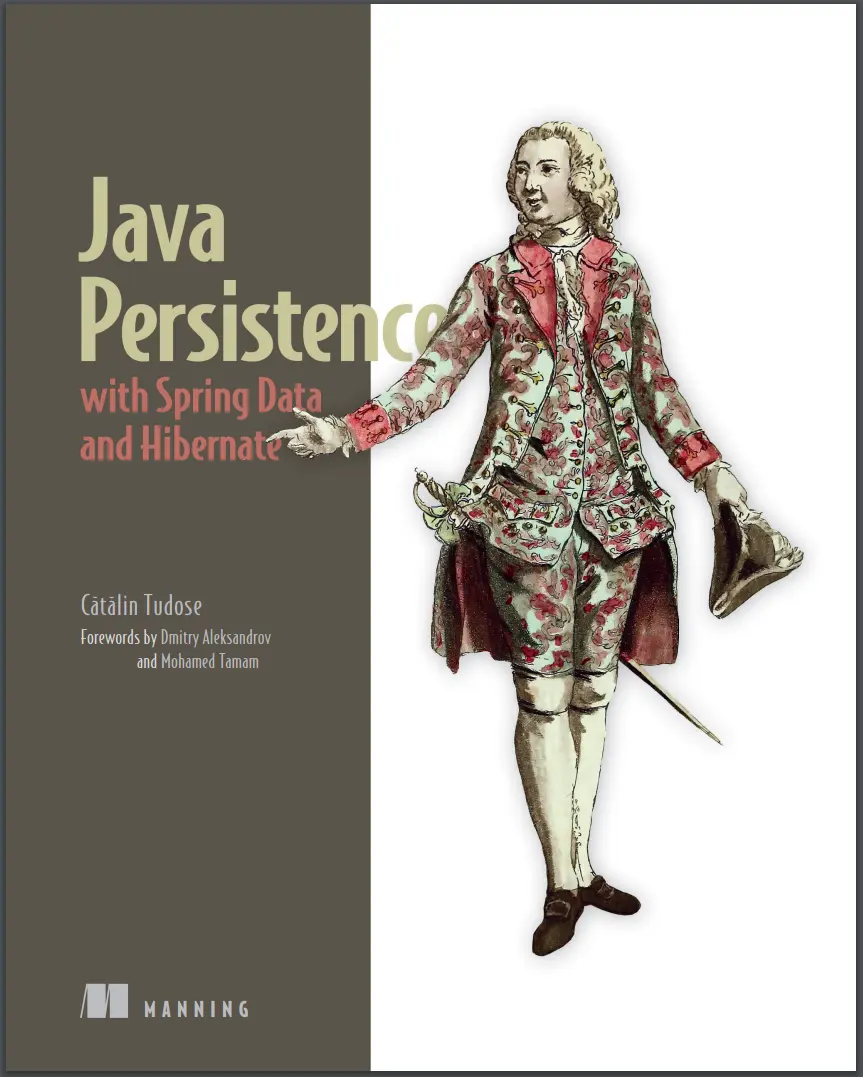
- Authors: Catalin Tudose Christian Bauer
- Release date: 2023
- Publisher: Manning Publications Co.
- Number of pages: 618
- File Size: 53,9 МБ
I am fortunate to have been in the IT industry for more than 25 years. I started programming in C++ and Delphi in my student years and the first years of my career. I made the step from my mathematics background as a teenager to computer science and continuously tried to keep both sides in my mind.
In 2000, my attention turned for the first time to the Java programming language. It was very new then, but many people were predicting a great future for it. I was part of a development team for online games, and the particular technology we worked with was applets, which was extremely fashionable during those years. Behind the application, the program needed to access a database, and our team spent some time developing the logic to access and interact with the database. Things such as ORM weren’t used yet, but we were able to develop our own library to interact with the database, shaping the incipient ideas of ORM.
After 2004, I spent more than 90% of my time working with Java. It was the dawn of a new era for me, and things like code refactoring, unit testing, and object/relational mapping were becoming normal in our professional lives.
Currently, there are a lot of Java programs that access databases and rely on higherlevel techniques and frameworks, such as JPA, Hibernate, and Spring Data. The old days of working with JDBC are hardly remembered. One of my activities as Java and Web Technologies Expert and Java Chapter Lead at Luxoft is to conduct courses on Java persistence topics and to coach my colleagues regarding the topic.
If you liked this book, share it with your friends, thus you help us develop and add more interesting and necessary books for you!